Data Center Boom Pulls HVAC Techs Off the Service Truck

Find HVAC Programs Now Enrolling Students

Get information on HVAC-R Certified Technician programs by entering your zip code and request enrollment information.

Sponsored Ad

“You don’t have the internet without HVAC.”

Bob Clark, EdD, HVACR Program Chair at College of DuPage

Data centers house the servers, storage, and network equipment that power the internet, cloud computing, and artificial intelligence (AI). As AI use grows, so do the number of data centers being built across the country and the electricity they use. Data centers consumed about 4.4 percent of all US electricity in 2023, according to Lawrence Berkeley National Laboratory, and the lab’s 2026 update estimates that share could reach 11.8 percent by 2030.

All of that equipment generates heat and has to be kept cool around the clock. According to the Congressional Research Service, about half or more of a data center’s electricity powers its IT equipment, and much of the rest goes to cooling. That cooling runs on chillers, cooling towers, pumps, and controls, so data centers need skilled HVAC technicians to install, operate, and maintain them.

“The thing that you should understand about data centers that most folks don’t look at is it’s not the five people or the 10 people that are running the data center that you have to concern yourself with. It’s the actual people that it takes to build the infrastructure and the structures that they have to reside in,” says Dr. Bob Clark, HVACR program chair at College of DuPage.

The US Bureau of Labor Statistics (2026) projects HVAC technician employment will grow 11 percent from 2025 to 2035, much faster than the average for all occupations, and lists commercial construction, including data centers, as a driver.

Keep reading to learn from Dr. Clark more about what data center employers need from HVAC technicians, the skills the work requires, and how students can train for it.

Meet the Expert: Bob Clark, EdD

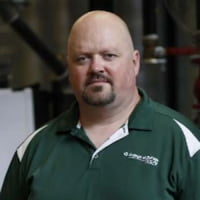
Bob Clark

Dr. Bob Clark is the HVACR program chair at College of DuPage in Glen Ellyn, Illinois. Before teaching, he worked in industrial maintenance and industrial refrigeration and ran his own HVACR business. He taught as an adjunct faculty member at Joliet Junior College for about three years before joining College of DuPage. He was named Postsecondary Career and Technical Educator of the Year by the Illinois Association for Career and Technical Education and has served as president of the Illinois Council of Air Conditioning and Refrigeration Educators.

Dr. Clark holds associate degrees in HVACR, industrial maintenance technology, and electrical and electronic automated systems. He also holds a bachelor’s degree in business and communications, an MBA in energy and sustainability, and a doctorate in career and technical education.

Why Data Centers Depend on HVAC

Servers constantly produce heat, and if it builds up, the equipment can overheat and shut down. According to the Congressional Research Service, most large data centers rely on centralized cooling that either moves chilled air through large ductwork or circulates chilled water through a piped loop that releases heat outdoors. Smaller facilities often use computer room air conditioners (CRACs).

Dr. Clark has watched AI change how colleges teach computer programming and engineering, with departments retooling as they need fewer programmers to do the same work. The mechanical side of the industry is a different story: “On our end, skilled labor, you still need HVAC technicians to manage the heating and cooling. You still need pipefitters to run all your heating and cooling. You still need mechanical contractors to install chillers. You still need duct systems put in, all these unique critical systems: generators, backups, gas, dual fuel systems,” says Dr. Clark.

Critical systems are the equipment a facility can’t run without, so a single failure can take an entire data center offline. That makes the technicians who install and maintain them essential to every cloud service. “You don’t have the internet without HVAC,” he adds.

The Skills Data Center Employers Need

An HVAC technician in a data center is responsible for the building, not the computers inside it. “You’re there to manage the data center. A company like Microsoft comes in and manages its own servers,” says Dr. Clark.

That means working on the same kinds of equipment found in hospitals, universities, and large office buildings, but at a larger scale and with no room for downtime. “You need a commercial hydronic perspective, and you need to understand critical systems and central plants. You have to have building automation knowledge and a SCADA overview. You have to be able to trend and analyze what’s happening with the energy systems and know how that affects your network,” he explains.

Hydronic systems use water to move heat, and a central plant is the group of chillers, boilers, pumps, and cooling towers that serves an entire building or campus. Building automation systems (BAS) monitor and control that equipment, and supervisory control and data acquisition (SCADA) software lets operators track it from a central screen. Trending means following performance data over time to catch problems before they cause a failure.

Why Reliability Matters in Critical Systems

Data centers are designed with redundant equipment, such as extra chillers and pumps, so the facility can keep running if one component fails. When an outage does happen, it is expensive. In Uptime Institute’s annual survey, 57 percent of respondents said their most recent major outage cost more than $100,000, and one in five said it cost more than $1 million, according to the organization’s 2026 Annual Outage Analysis. The same report found that failing to follow established procedures is the leading driver of human-error outages.

“Data center people have to have confidence that students aren’t coming out of school pacified with PowerPoint presentations. They want to know: Are they going to start crying when the data center melts down? They need technicians who are reliable and know how to manage an absolutely crazy situation with a critical system. So program integrity is everything,” says Dr. Clark.

For Dr. Clark, that reliability starts with how students learn the science of heat transfer. “You need to understand thermodynamics from a technician’s perspective, not an academic engineering perspective. If the cooling tower doesn’t have water, you know to go find a hose and put water in it, not run 12,000 math problems. If a critical system breaks down, your technician better be able to think around that, and that’s what they’re paying for: reliability,” he adds.

How to Train for Data Center HVAC Work

Not every HVAC program prepares students for data center work. “You have to have a commercial program. The programs are kind of pieced out across multiple programs, where it’s facility maintenance, you need some HVAC, you need building automation,” says Dr. Clark.

At College of DuPage, those pieces include a building automation systems certificate, a stationary operator certificate, and a facility maintenance mechanic associate degree, all part of the school’s HVACR program: “We put together an actual data center certificate. We designed the curriculum our way, and we used actual data center people and industry experts to help us craft it,” he explains.

The college developed the 34-credit data technician certificate through a grant partnership with Northern Virginia Community College. It covers refrigeration, hydronic heating, central cooling plants, facility electrical systems, building automation, and an introduction to networks. “The Data Center Technician certificate stacks into a track for the Facility Maintenance Mechanic degree,” Dr. Clark notes. Stackable credentials let students earn a certificate, start working, and later apply those credits toward an associate degree.

The EPA requires nearly all HVAC technicians to hold Section 608 certification for handling refrigerants, and the data technician certificate includes a refrigerant certification course. Dr. Clark doesn’t see another certification that gives graduates a clear edge yet. “Maybe some small safety certs. I will be working on this with some organizations over the coming year,” he adds.

Hands-on training is central to the program. “We have a 13,000-square-foot lab that’s built by our students, not contractors, to let contractors know exactly that we mean business,” Dr. Clark shares.

Union training is another common route into the field. “In Illinois, how most data centers run is you have a hall like 399 supplying them. We work with them, and our students go that route. They’re educating their folks with data center work in mind too, like we are,” he says.

Local 399 is the International Union of Operating Engineers local that represents stationary engineers in the Chicago area. Stationary engineers operate and maintain the boilers, chillers, and other mechanical equipment in large buildings. According to the US Bureau of Labor Statistics (May 2025), they earned a median annual wage of $78,620, compared with $61,010 for HVAC technicians—the latest data available as of October 2026.

“Residential, facility, light commercial, warehouse support, and mechanical contractors all pay well. It’s up to what the student wants to experience and turn into a career,” advises Dr. Clark.

The Future of Data Center HVAC Training

Data center growth is only one part of the HVAC workforce story. “There are way more jobs in residential. The numbers are not even close. Residential really needs to be concerned with retirements. The cost is already showcasing the problem nationally,” says Dr. Clark.
Dr. Clark hasn’t yet seen many students enroll specifically to work in data centers. He believes that will change once the field gets the kind of public outreach that once drew students into nursing, from high school campaigns to fully paid tuition.

He is also working to help other instructors catch up. He recently led 35 HVAC teachers on a tour of a data center in Omaha, Nebraska, where a former College of DuPage student works as the chief engineer. “These teachers need help. If we’re going to have a data center technician, it can split with facilities, but you have to have commercial equipment. You have to have that perspective. Right now, we’re building a model to create a trainer at COD with our students, and we’re starting to build that out this year. We share that stuff with people all over the country,” notes Dr. Clark.

Kimmy Gustafson

Kimmy Gustafson

Kimmy Gustafson is a freelance writer with a passion for sharing stories of bravery. Her love for world-traveling began when her family moved to Spain when she was six and since then, she has lived overseas extensively, visited six continents, and traveled to over 25 countries. She is fluent in Spanish and conversational in French. When not writing or parenting she can be found kiteboarding, hiking, or cooking.

Related posts

scholarships-200x200

October 05, 2026

Various apprenticeships and trade, technical, and degree programs offer training. Not surprisingly, completing an accredited HVAC program can make it easier to secure lucrative employment; however, paying for school can still be a challenge.

iStock-514936337 (1)

September 14, 2026

The principal health threat in wildfire smoke is fine particulate matter. It’s what makes a smoky sky look hazy. Fine particulate matter can travel hundreds or thousands of miles, sneaking into buildings and penetrating deep into a person’s lungs or even the bloodstream. Numerous scientific studies have linked particle pollution exposure to a variety of serious health problems (EPA 2026).